%20Jack%20Megrue.avif)

Emerald AI Announces First DSX Flex Deployment With NVIDIA and Silicon Valley Power, and Applauds Texas Fast Track for Flexible AI Factories
At the launch of NVIDIA DSX OS at GTC Taipei at COMPUTEX 2026, Emerald AI announces its collaboration with NVIDIA on scaling grid-responsive AI infrastructure from demonstration to commercial deployment in Silicon Valley — and equipping AI factories for ERCOT's new framework for faster power access in Texas.


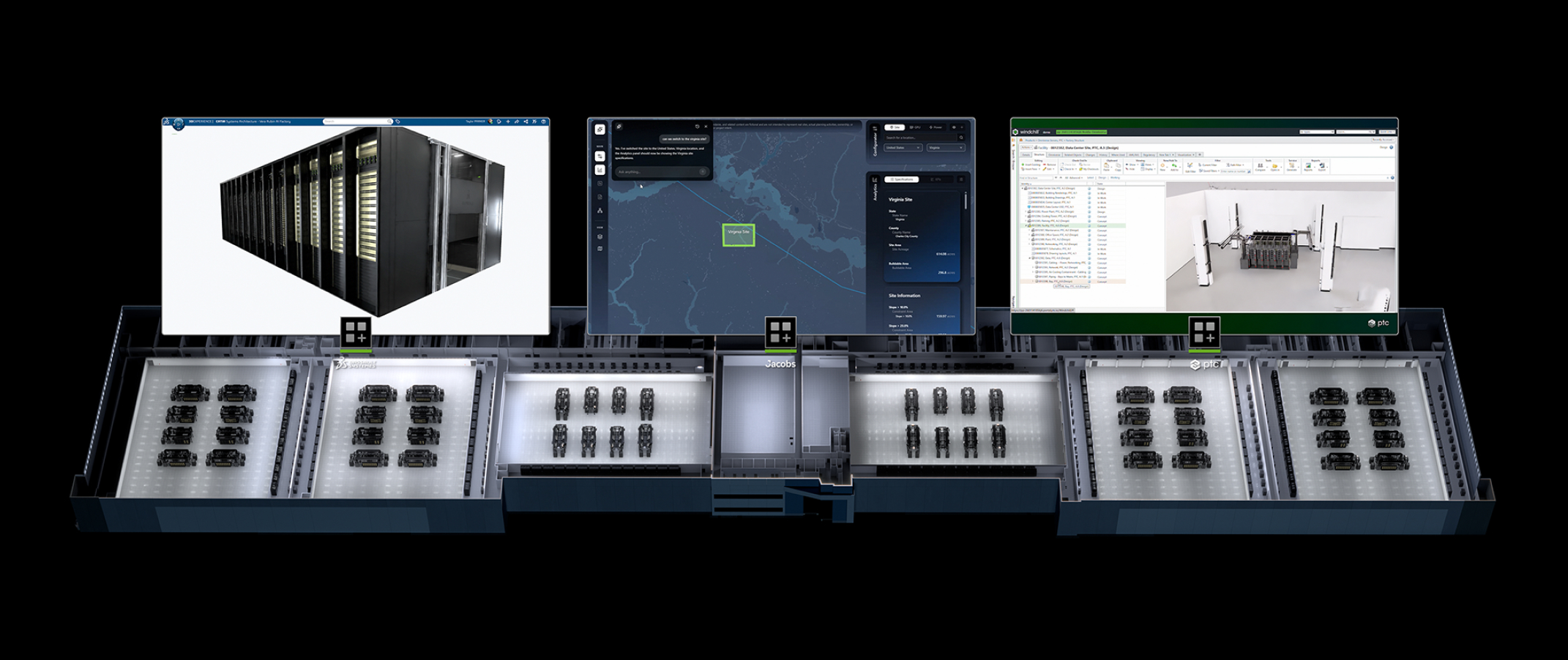
At NVIDIA GTC Taipei at COMPUTEX 2026 today, Emerald AI announced the first commercial, multi-megawatt deployment of NVIDIA DSX Flex, in partnership with NVIDIA and Silicon Valley Power (SVP), the municipally owned utility of Santa Clara, California. The deployment is made possible by SVP's first-in-the-nation Flexible Load Interconnection Program — the pioneering utility framework proving that grid-responsive AI factories can unlock real power capacity for AI growth without forcing ratepayers to fund years of transmission build-out.
Separately, Emerald AI applauded a major regulatory breakthrough in Texas: the Provisional Controllable Load Resource (PCLR) framework recently advanced by ERCOT, which opens a fast track for flexible data centers to access more power from the Texas grid under certain conditions ahead of traditional interconnection timelines. Emerald AI is ready to partner with data centers and AI cloud providers who want to access faster power capacity in ERCOT through this new framework.
A pioneering utility program meets a production-grade technology stack
SVP has led the country in opening a regulatory pathway for flexible AI factories. Its Flexible Load Interconnection Program is the first-in-the-nation utility program that offers data centers expanded grid access in exchange for verifiable, dispatchable flexibility — a model that lets new AI capacity come online faster on existing infrastructure while protecting reliability and affordability for the broader community.
Under the deployment, Emerald AI's Conductor platform — tightly integrated with NVIDIA DSX Flex — will enable SVP to dispatch a participating AI data center during periods of grid need. Conductor dynamically modulates the facility's power consumption in real time in response to SVP signals, while preserving the performance of NVIDIA AI workloads running on advanced GPUs at the site.
This is the first commercial DSX Flex deployment, and it builds on five prior live demonstrations of Conductor with NVIDIA systems at commercial data centers across two continents.
DSX OS arrives — with power flexibility built in
NVIDIA's launch of DSX OS at GTC Taipei is a turning point for the industry. DSX OS is the operating layer for AI factories at scale, and DSX Flex, integrated with Emerald's Conductor platform, is delivered as a built-in power flexibility within DSX OS. Power flexibility is now part of how next-generation AI factories are built and operated by design, not bolted on after the fact.
Together, the two milestones close the loop:
- A regulatory model — utilities like SVP offering expanded, faster grid access in exchange for verified AI factory flexibility.
- A technical solution — DSX OS with DSX Flex and Emerald Conductor, proven in five commercial demonstrations and now deployed commercially.
A 96-megawatt commercial-scale deployment is planned later this year at NVIDIA's AI Factory Research Center in Manassas, Virginia, in collaboration with Digital Realty, EPRI, and the PJM Interconnection.
"AI's energy demand and grid reliability don't have to be in tension — but resolving that requires software that can act at the speed of the grid in real time, and a utility framework that rewards it," said Varun Sivaram, founder and CEO of Emerald AI. "Silicon Valley Power's Flexible Load Interconnection Program proves the regulatory model works. NVIDIA DSX OS, with DSX Flex and Emerald Conductor embedded, proves the technical model works at commercial scale. Every utility and every operator in the country can now see what the next decade of AI infrastructure looks like."
Texas supersizes the opportunity
The Silicon Valley deployment arrives as Texas opens a fast track for flexible AI factories at a vastly larger scale. ERCOT's Provisional Controllable Load Resource (PCLR) framework is a keymechanism for integrating massive new loads — including hyperscale AI data centers — onto its grid. PCLR will allow large loads to access more power ahead of traditional timelines, provided they can operate flexibly and self-manage power when curtailed.
Building the grid infrastructure needed to deliver capacity in Texas today takes five to seven years. PCLR creates a parallel track that lets AI factories utilize existing grid headroom while waiting in queue for firm power, and operate as shock absorbers for the grid — exactly the model Emerald's software is built to enable.
Emerald AI strongly supports the high-level framework that ERCOT has greenlit and is ready to work with data center and AI partners to equip them to participate under the new framework and access swifter power connections. Emerald AI and NVIDIA, working with NVIDIA Cloud Partners, are aligning to help AI factories built on NVIDIA Vera Rubin DSX AI Factory reference design with DSX Flex meet PCLR requirements from day one. Emerald AI invites data center developers, cloud partners, and AI factory operators with projects in ERCOT — and other grids advancing similar frameworks — to discuss the path to flexible interconnection. With time-to-power now the biggest constraint on the AI build-out, PCLR is the largest near-term unlock in the country.
"ERCOT has established a transformative paradigm for large-scale load integration, setting Texas at the vanguard of flexible data center operations," said Michael Panfil, Head of Legal & Policy at Emerald AI. "This framework is precisely what is required to catalyze infrastructure investment, drive affordability, and equip grid operators with the essential mechanisms to ensure reliability amid soaring AI demand. We applaud ERCOT's leadership and look forward to working with the state, with NVIDIA, and with cloud and data center partners to make PCLR a reality on the ground."
The PCLR framework builds on policy groundwork led by Emerald AI Executive Advisor Arushi Sharma Frank, whose earlier ERCOT protocol filing in November 2025 paved the conceptual and regulatory foundation for turning large flexible loads into a grid asset solution.
The bigger picture: up to 100 GW on existing infrastructure
The stakes extend far beyond a single utility or a single state. Recent analysis indicates that if the U.S. grid operated flexibly, up to 100 GW of additional capacity could be unlocked on existing transmission infrastructure — power available today, without multi-year build-outs. The Silicon Valley deployment and the Texas PCLR framework are the first commercial and regulatory proof points for how that unlock happens in practice.


